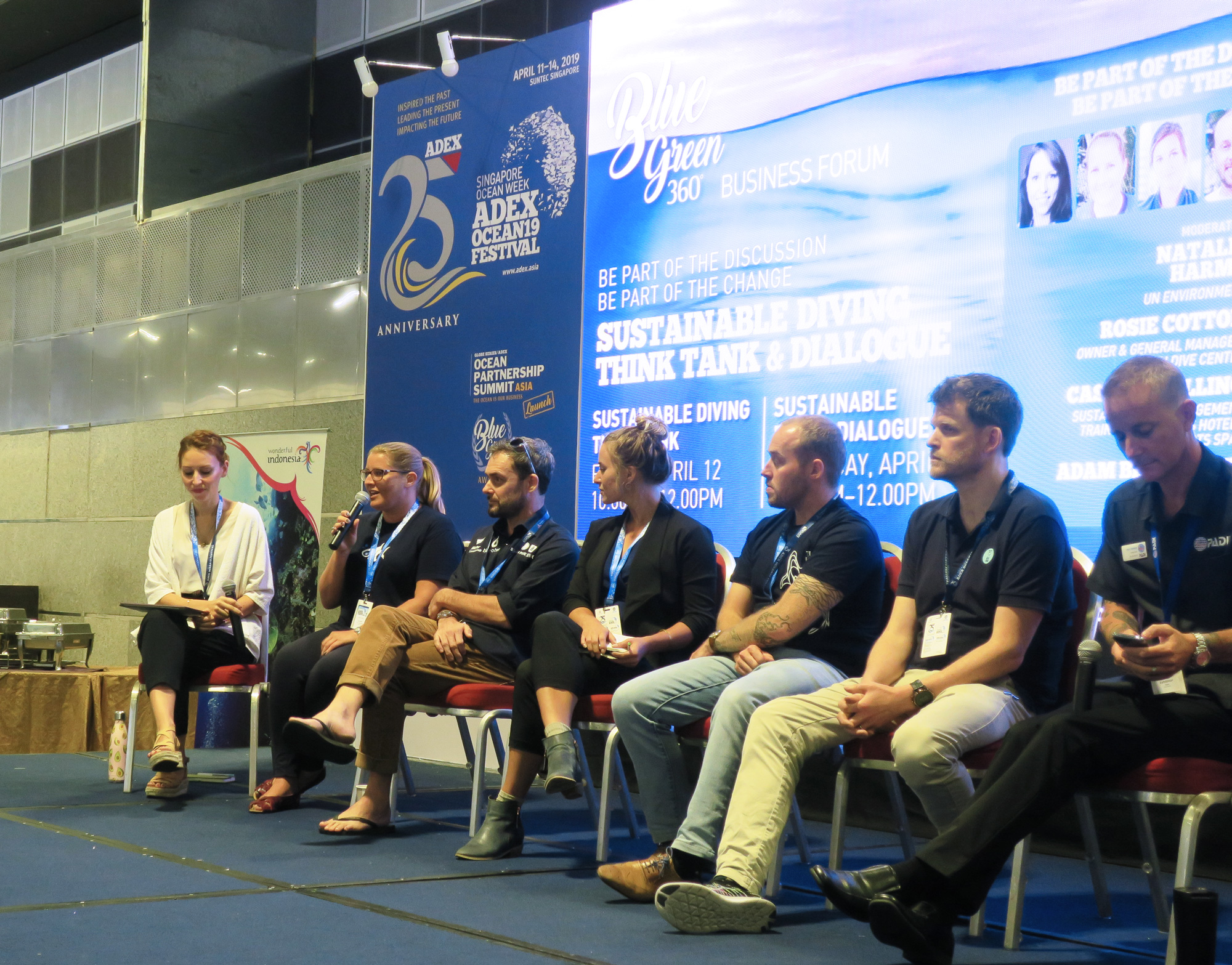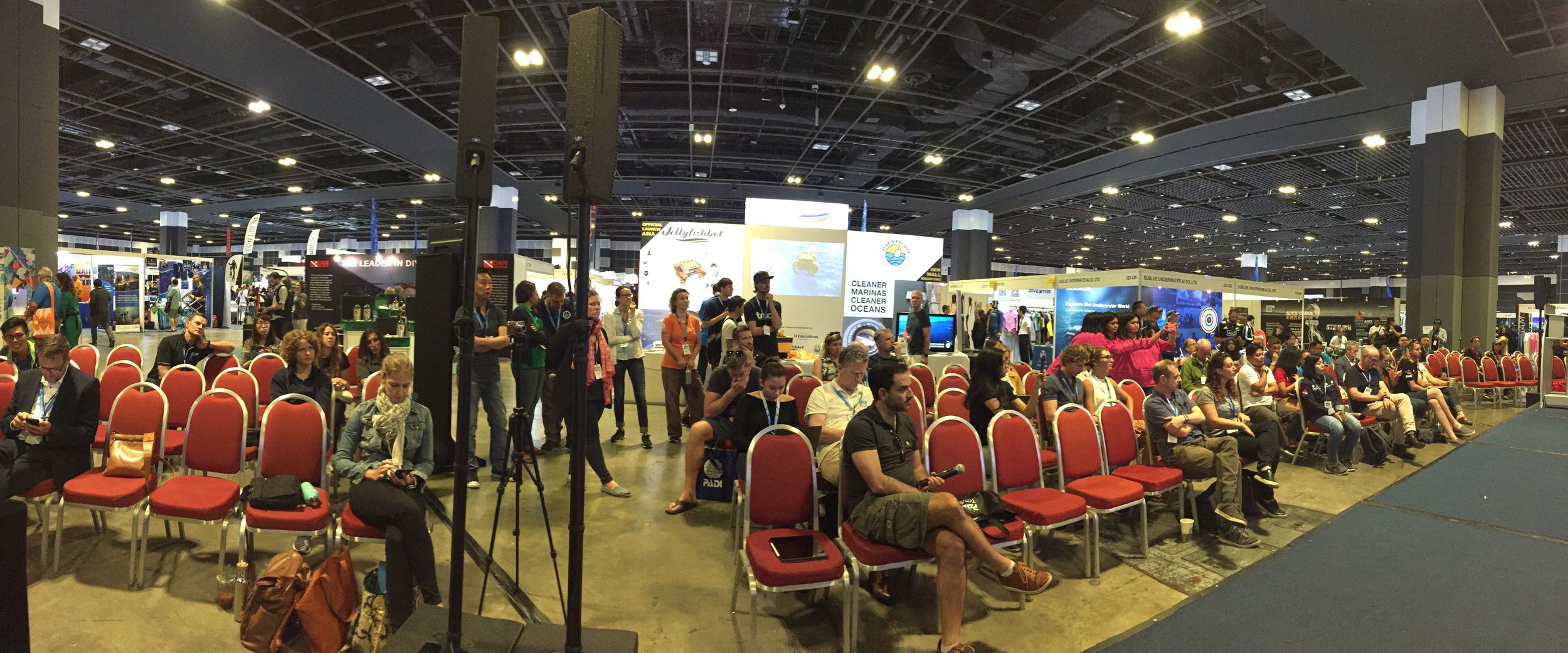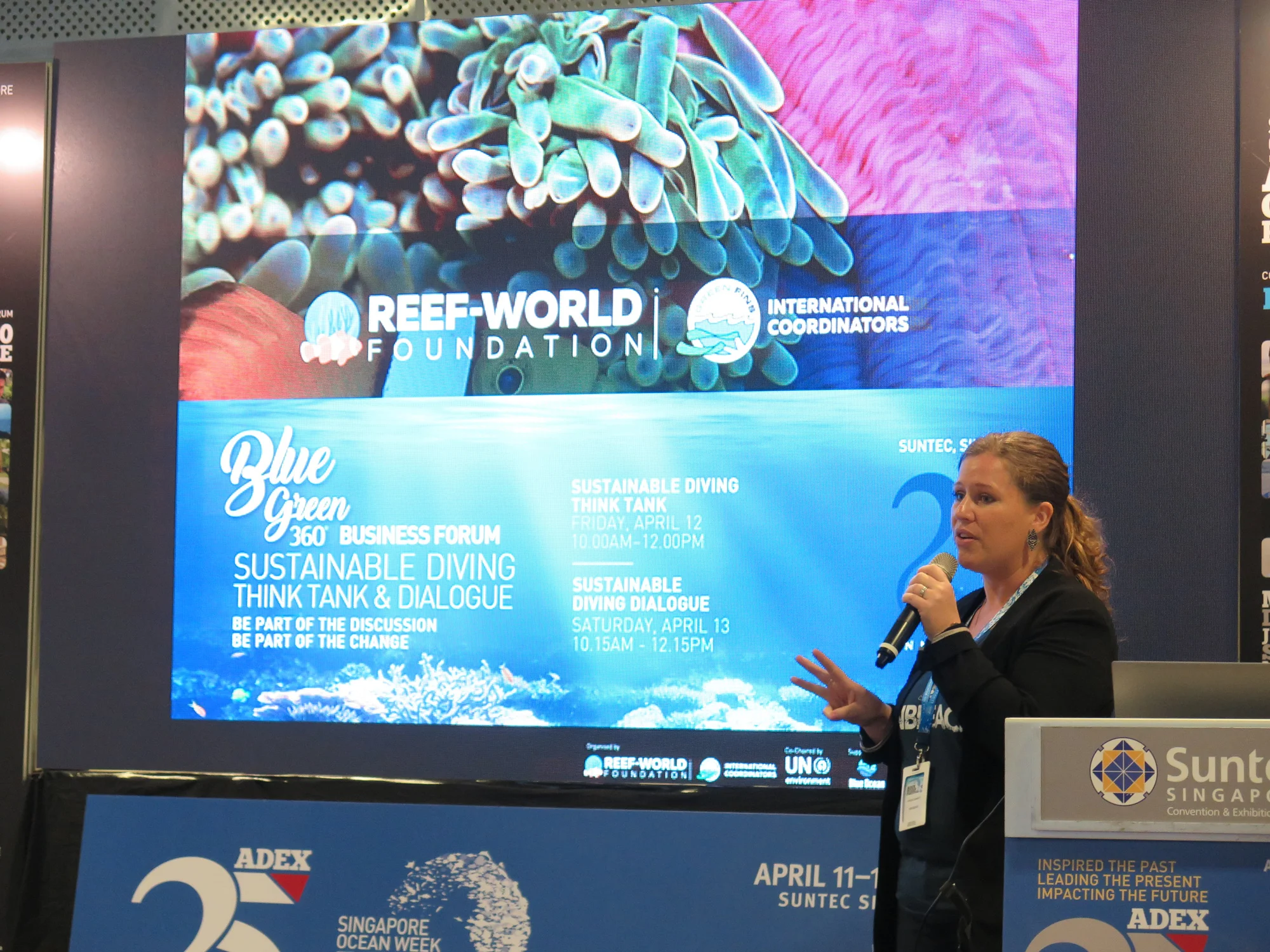
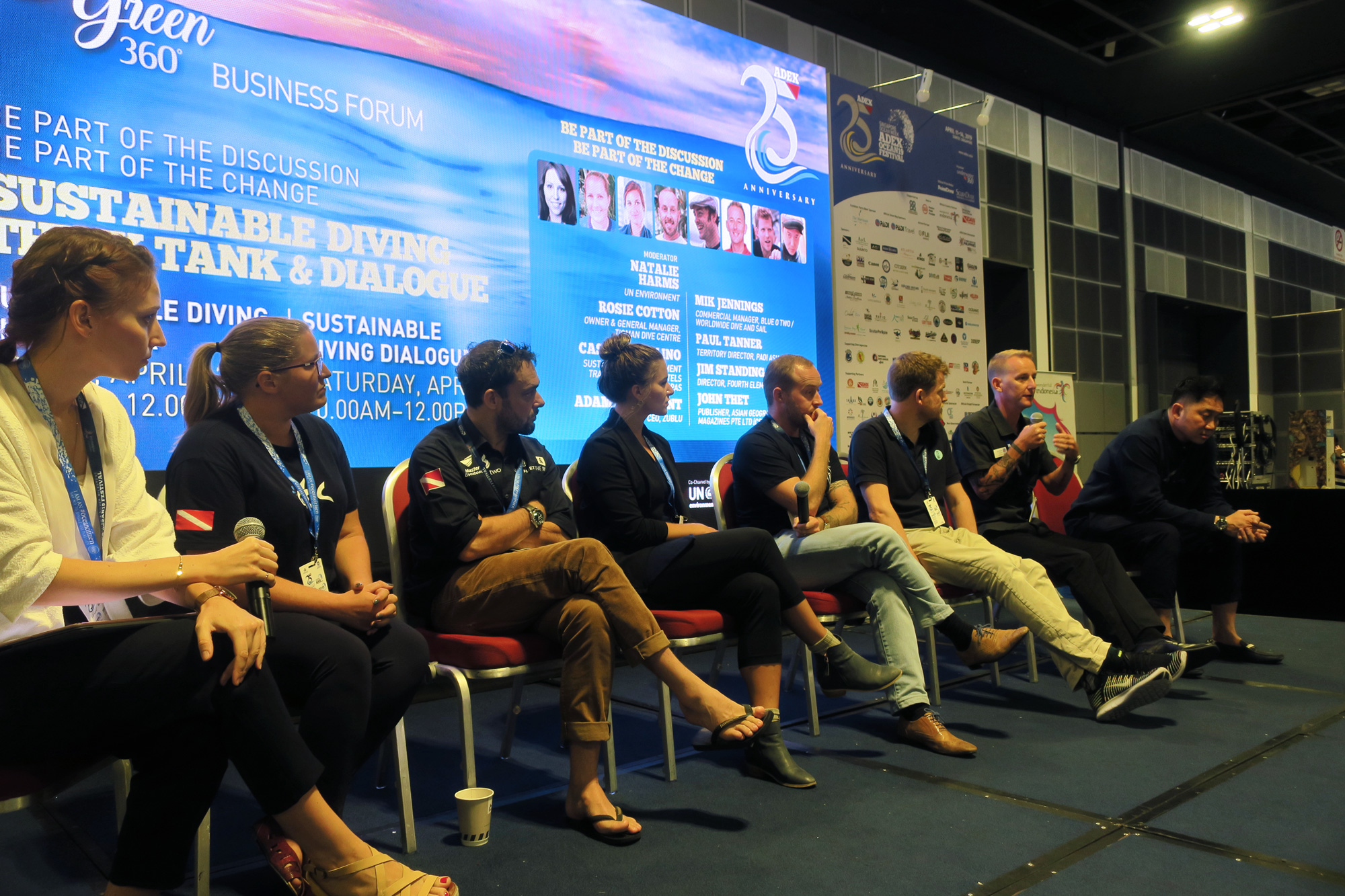
The Sustainable Diving Dialogue was a public Q&A with a panel of seven industry leaders showcasing the steps they are taking towards industry sustainability; in particular, the reduction of ocean plastics.
The Dialogue was chaired by Natalie Harms from the UN Environment, organised by Reef-World, hosted by UW360 and supported by Blue Ocean Network.
The panellists were:
-
Adam Broadbent, co-founder and CEO of ZuBlu; a travel platform helping scuba divers and marine enthusiasts discover and book their next underwater adventure in Asia
-
Cassian Bellino, sustainbility management trainee at Six Senses luxury hospitality group, which has a strong focus on sustainability and wellness
-
Jim Standing, founder and director of Fourth Element; a brand that reflects a passion for diving and a growing need to preserve the ocean environment for future generations
-
John Thet, CEO of Asian Geographic Magazines, which celebrate Asia's diversity and covers issues including the environment, science, exploration, travel and heritage
-
Mik Jennings, Commercial Manager at blueotwo - liveaboard and resort-based scuba diving specialists - and diving liveaboard operators Worldwide Dive and Sail
-
Paul Tanner, Asia Pacific Territory Director at PADI
-
Rosie Cotton, Owner and General Manager of Tioman Dive Centre in Malaysia
Natalie Harms opened the Dialogue by sharing UN Environment’s efforts in the region to promote the sustainable use of our oceans by bringing together governments, businesses and civil society to tackle plastic pollution and green the diving industry through Green Fins. While the dive industry may only play a relatively small part in the destruction of the region’s astonishing marine ecosystems and biodiversity, Harms highlighted the important role the dive community can play in conserving the environment it so fundamentally values and depends on.
Natalie asked Rosie and Mik: What are some of the solutions and key lessons for more sustainable dive operations you would like to share, what challenges do you face?
The Dialogue began with thoughts from Rosie Cotton from Tioman Dive Centre who had just won the Green Fins Award. Rosie thanked Green Fins and her own team and explained they see their progress as a series of small events. Each year, the Green Fins team gives them tips and recommendations so they can take things step-by-step: from things like removing dead coral fragments in the dive shop to providing an environmental dive briefing. It’s only three things at a time so it never feels overwhelming, but 5 years later and they’ve made it to #1. She highlighted the importance of consistency and instilling the message in her staff so they can transmit relevant information to their customers who will, likewise, take it with them and hopefully share with friends and family.
Mik Jennings, from blueotwo and Worldwide Dive and Sail, talked about how he has been working on the greening of liveaboards. He highlighted that humans are the biggest threat to the environment and that the more people there are underwater, the bigger the footprint collectively will be left. He mentioned that a lot of governments have MPAs but questioned whether they are properly policed and stated that policing the number of people visiting them is key. He talked about the fact that one small company can do very little alone but that getting strength in numbers is a challenge. In particular, he talked about the difficulty in obtaining the products needed for offering sustainable diving services. For example, his company is in 15 countries but if they were to buy centrally and distribute across their network, they would have an even bigger footprint so they have to co-ordinate within each of the 15 countries. This is particularly challenging for livaboards.
Audience question: Are companies being rewarded for being sustainable? And how are people responding?
Jennings responded that they receive a very mixed response: some people choose holidays based on who is sustainable and some people just don’t care. When blueotwo announced on Facebook they were removing all single use bottles from their Red Sea fleet, there was a backlash from customers who felt the convenience had been taken away from them. Yet, Jennings highlighted that people are becoming more aware in general and that businesses will lose out in the long run if they don’t take their businesses in a more sustainable direction.
Jim Standing, Fourth Element, added that it’s hard to reward companies for being green but, frankly, we have to do it. If we don’t, the future is incredibly stark. It’s more expensive for us to do it as manufacturers, but we don’t have a choice. Fourth Element has accepted the higher cost and some of the kickback of making their product more expensive. But, fundamentally whether it’s five, 10 or 20 years down the line, there will be no environment left if we don’t do this. He is passionate that we have to do this until consumers have no choice but to be green.
Adam Broadbent, ZuBlu, mentioned that a survey done last year by Booking.com revealed that 68% of their travelers are more likely to choose accommodation if its eco-friendly or sustainable. He said it’s hard to rank how rewarded businesses are but that this has to become the norm. While being sustainable can currently be used as a marketing benefit, eventually it will become the status quo and you’ll get left behind if you don’t follow.
Audience question: What kind of solutions can resorts and liveaboards collaborate on together?
Rosie Cotton, Tioman Dive Centre, noted that, while TDC is a small dive centre, there are issues with liveaboards, especially regarding anchoring on reefs. She felt there is little collaboration between resorts and liveabords and that has to change. Whether it’s through an entry fee, engaging with community and dive association etc, liveaboards should be more involved.
Natalie asked Six Senses: What are the key solutions you work on?
Cassian Bellino, Six Senses, explained that they encounter issues with distribution - for example, transport and customs making it difficult and expensive. Yet, as a wellness and sustainability brand, they want to be true to their mission and hold their company to set standards. This, she said, can only be done by communicating well. She gives reef-safe sunscreen as an example: while there is currently a lot of research going on around sunscreen, Six Senses is taking a precautionary approach to be environmentally friendly. She also said Six Senses is committed to being plastic free by 2022 in 37 resorts. They are trying to innovate with current suppliers, work with new suppliers and make old suppliers catch up when it comes to sustainability. Solutions, she said, are coming in slowly.
John Thet, CEO of Asian Geographic Magazines, noted that they’re looking for such positive stories featuring green companies. He stresses the importance of editorial integrity and that his magazines do not cover things that destroy the environment.
Natalie asked ZuBlu: Is the demand for sustainable tourism growing?
Broadbent explained that the ZuBlu platform aims to showcase sustainable liveaboards and dive resorts. ZuBlu plays an important role in helping to educate and showing consumers what is available. While price still trumps for now, he says people are making decisions based on eco friendliness and it’s very exciting for the ZuBlu team to be able to educate people about what is out there. They are seeing demand for citizen science experiences and getting involved in conservation work while travelling. In terms of pre-travel, he says, sustainable travel starts from home - that’s where you have the biggest impact. He gives the example that by choosing a Green Fins member, you know you’re making a lower impact.
ZuBlu wants to try to encourage more of its guests to be activists or citizen scientists once in destination and rewarding them for that by giving them a discount on their next ZuBlu trip so they will book through the platform again. He notes that not many people are purely altruistic and rewarding people is the best way to engage them to do conservation work.
Audience question: In areas that are popular for diving and might see 10-12 operators on one site, how do we get everyone else to do the right thing when maybe only one or two are sustainable?

Paul Tanner, from PADI, said there wasn’t a direct answer for that question because it depends what level each company is on the ladder to becoming sustainable and their commitment to doing so. The dive centres here at the ADEX Sustainable Diving Dialogue are the ones who are keen and those dive centres who are not investing in this will either destroy the community they’re in or more sustainable operators will take their clients. He notes that it’s very expensive to do on a large scale and it always comes down to the community level: for example, in the Gili Islands, there is a limit of two boats per mooring to manage the impact of diving locally.
Audience contribution: Jeroen van de Waal, founder of Orca Nation, added that they are focusing on education for kids. They connect with kids in capital cities and greater metropolitan areas, educate them about what they do and inspire them to see the future differently. He noted that many of these children have parents who work in multinationals so they are trying to flip around the educational paradigm. In 2030, he says, we reach the tipping point, which is especially scary for the young generation.
Natalie harms, UN Environment, agreed about the importance of the next generation.
Audience question for PADI: When he learnt to dive, the instructor really focused on respect for the ocean i.e. making all students an ambassador for the ocean. Why has that focus been lost in PADI divers?
Tanner, PADI, responded that, in his opinion, it’s done now more than ever. He said PADI is revising all its materials and teaching this environmental messaging to all students. He says that every single student he’s taught has fallen in love with the ocean and that he, himself, didn’t love the ocean until he learned how to dive. He said the diving industry is driving the change and people are really becoming ambassadors when it comes to plastic, pollution etc. There’s no entity pushing harder for sustainability than PADI, he said.
Harms asked: Do you think sustainable dive tourism has an edge already?
Standing, Fourth Element, said the short answer is yes, there is a competitive advantage for sustainable businesses. He mentioned that six years ago Fourth Element understood there was a problem with ghost fishing nets and decided they should produce something out of waste material. This expanded and informed their thinking and now they have an Ocean Positive swimwear line made from sustainable materials. Once you look into the rabbit hole, he said, you can’t come back out. It fundamentally changed the DNA of our company to one where we make a product that is better for the ocean and is as sustainable as possible. For Fourth Element, it’s become a journey where the company will work towards eliminating single use plastic by 2020 and consumers are responding very positively.
Standing stresses that Fourth Element is just a small part of something that is going to become important to everybody, which is why they created Mission 2020: we wanted to make the whole industry committed to this by engaging other businesses who love diving so we can take an action as a group. Businesses who have pledged are making significant changes and Standing hopes we can all make changes that will inform divers around the world. The diving community has the power to make a change and Fourth Element is leading the charge. He encouraged everyone to join, learn from others and be inspired.
Chloe Harvey, The Reef-World Foundation, asked: What can we do as a community to try and get other manufacturers on board?
Standing replied the best thing to do is to vote with your wallet! He explains that, as a small company, Fourth Element is working with some of the big companies to share their lessons and encourage others to follow in their footsteps. He also says it’s no longer true that you have to sacrifice performance because of sustainability: now Fourth Element uses recycled materials, their quality is even better. He encouraged businesses to talk to each other and share ideas; and even offered to share where they source their materials with other companies.
Harms asked PADI: what are the plans for PADI to adopt environmental content in the training materials?
Tanner, PADI, replied that it’s about education, education, education and community, and communication. He also mentioned that PADI is driving the movement by trying to bring out more courses to educate divers to become citizen scientists and ensure that data is used effectively. He said three to four years ago, PADI implemented a sea change in how they approach their teaching. As a result, they are putting out materials and encouraging divers to drive sustainability and combat climate change. He said more courses will be coming from PADI aimed at education and citizen science with a focus on seagrass, climate change, etc. They are also collecting as much data as they can. For example, talking to manufacturers about BCDs that can tell us what kinds of environment we’re diving in. They are also reviewing standards for dive resorts where credit may be given to environmental dive centres and using their social reach of five million to push the message of sustainability throughout their network. Tanner said dive centres can expect to see changes in the next months and years.
Harms asked ADEX: Are we doing enough? How will ADEX develop to support these kinds of issues?
John Thet replied that our industry depends on the ocean so we have to take care of it. He noted that everyone has a responsibility to give back and that ADEX is going in that direction and wants to give back to the ocean but that not enough is being done which is why they will repeat their theme of no plastic waste next year. While ADEX usually changes its theme annually, they don’t feel they’ve had enough time to cover this important issue so will cover the theme again. He mentioned that plastic is a problem that’s hard to resolve: people only recycle 9% of their plastic and it’s cheaper to make new plastic than to recycle it. Business-wise, that’s a tough choice. At next year’s ADEX, Thet said, they would like to have CEOs, governments and ministers join a discussion about how this can be done better as well as having announcements from companies on their pledges for sustainability. However, he noted, we have to start with our own company’s mission first before we look outside.
Thet also highlighted that ADEX had saved thousands of plastic water bottles the previous day by providing refillable water stations. He returned to the point that if there are more divers, there will be more ocean lovers, but that these divers have to be educated so the increase in divers doesn’t lead to damage to the environment.